
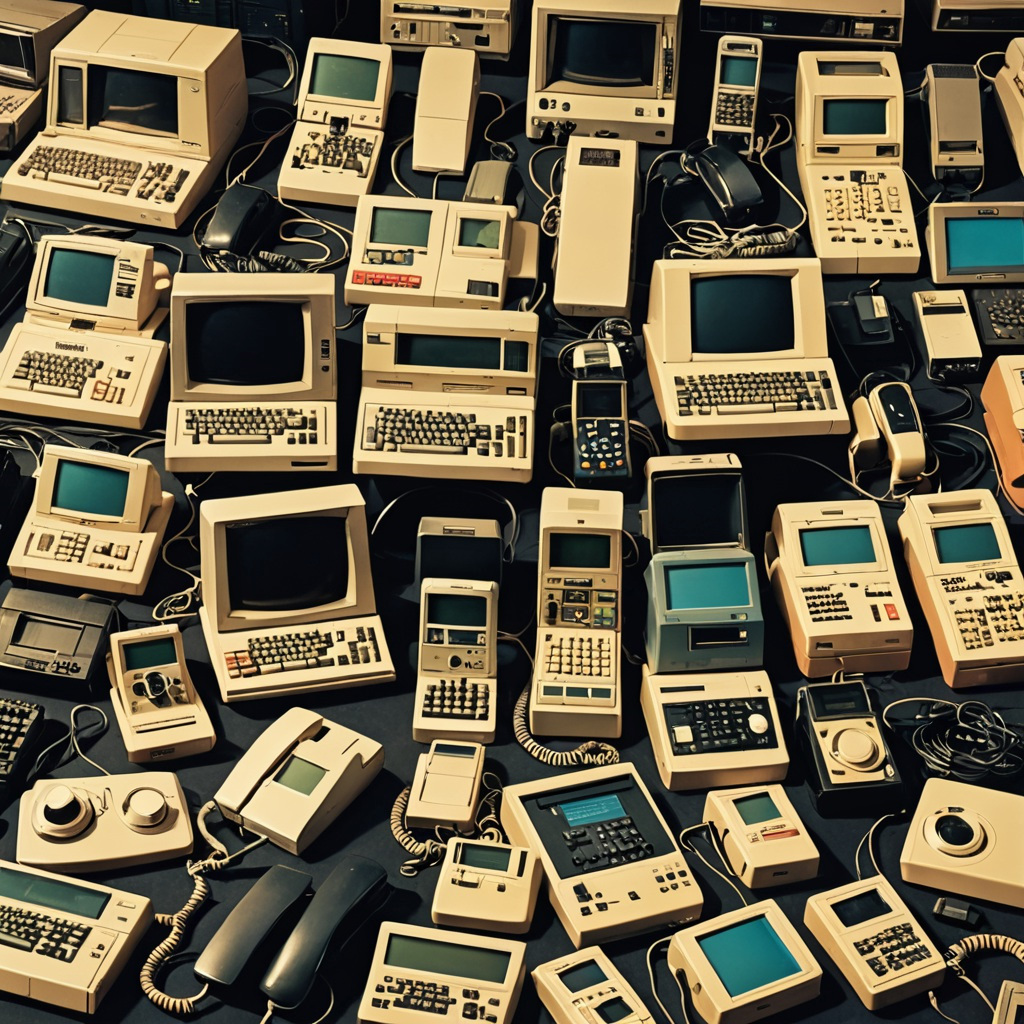
Welcome to the X Factor: An Anthropocene Audit.
We, Generation X, are defined by a singular, pivotal experience: we learned to speak fluent Analog just as the world began to stammer in Digital. We were the pivotal consumers—the ones who saw the physical, analog world of our parents—and the digital, decentralized world of our children—and had to build the bridge between them.
Growing up, we were caught between two worlds of information: the old world of broadcast TV and far-off events, and the new world of personalized feeds and instant everything. This tech-filled youth taught us some big lessons every day about control, scarcity, and the need to adapt—fast.
The Official Story: When Information Was a Controlled Substance
In the 1970s and early 80s, information was tightly managed. You got your news when the state or the network decided to give it to you. The media was a monolith, a tool for either national cohesion or outright ideological control.
From the BBC in England to the state-run networks in France and the pervasive, filtered reach across the Soviet Bloc and China, the official narrative was limited by the broadcast antenna. Even in cautious democracies like Spain, newly emerging from the Franco era, the culture of centralized authority lingered over the airwaves.
This bottleneck was arguably at its most consequential across Africa. In nations like South Africa, the state weaponized broadcast control to enforce segregation and limit exposure to global protest. Elsewhere, sheer infrastructural poverty meant the official story, when it arrived, was slow and inherently distrusted.
The Democratic Rebellion: Cassettes, VCRs, and Soft-Power Osmosis
The revolution, of course, was small, cheap, and made of plastic. Our adolescent uprising was fueled by The Cassette Tape and The VCR. These devices, often sourced from the surging factories of Southeast Asia, were the tools that shattered media monopolies.
The Walkman wasn’t just a gadget; it was a manifesto for the individual, allowing us to create a private world that defied the communal sounds of the previous generation. Across the globe, from the suburbs of Australia to the housing estates of Italy, the tape deck became our clandestine printing press.
This decentralized technology immediately normalized piracy. Copying music and bootlegging movies wasn’t seen as a moral failure; it was a necessary act of cultural acquisition—a way to bypass state-sanctioned scarcity. In China, the first glimpses of Western culture arrived via bootlegged cassettes. In South Africa, VCR tapes became a critical, clandestine source of political news and global protest that the Apartheid state fought tirelessly, and unsuccessfully, to block. The VCR was arguably one of the greatest—and ugliest—democratic tools of the 1980s.
The Code Whisperers: The Personal Revolution
Then came the home computer—the Commodore 64, the Apple II, the ZX Spectrum. This was where the pivot truly took hold. These machines weren’t for consuming content; they were for creating it.
Before the graphical interface smoothed everything over, you had to learn the system’s architecture. For a Gen Xer, the phrase LOAD “*”,8,1 isn’t gibberish; it’s a quiet fluency in the machine’s inner workings. This is our inherent advantage: we understand the mechanism, not just the interface.
In homes from France to the United States, small cohorts began building worlds in BASIC. Meanwhile, in nations of the Soviet Bloc, where Western technology was fiercely restricted, engineers and enthusiasts built their own versions from scratch, fostering a profound early DIY hacker culture born out of economic and political constraints. We learned that technology was never neutral; it was a tool of control until we figured out how to subvert it.
The Anthropocene Audit: Our Plastic Legacy
The great irony of the Analogue Bridge era is the physical mess it left behind. We inherited the post-war obsession with plastic, transforming it into disposable culture: cassette cases, VHS clamshells, floppy disk sleeves. We normalized the idea of planned obsolescence—the annual requirement to upgrade—which we simply viewed as “progress.”
We didn’t just usher in the Silicon Age; we laid the groundwork for the global addiction to cheap hardware and the ever-growing mountains of e-waste. Our first fluent digital conversation came at the expense of a cleaner physical world.
The Anthropocene Audit: Our Digital Resilience
The irony of the Analogue Bridge era is that while we enabled the e-waste problem, we simultaneously developed the core skill that defines the global digital economy: Resilience.
Because we had to physically fix a broken tape with a pencil, manually adjust a TV aerial, or type a multi-line command to load a game, we developed an innate, practical understanding of failure. We know that technology is fragile, often unreliable, and always requires human intervention.
This hands-on, problem-solving ethos—born from necessity—is our great, unsung contribution. We didn’t just adapt to the digital world; we learned to master its mechanics. We are the generation that can still diagnose a glitch without panicking, because we remember a time when the entire machine had to be physically restarted. We learned to innovate around scarcity, to fix what was broken, and to treat every technological barrier as a puzzle to be solved alone. That self-reliant ingenuity is the gold standard we set for the digital age.
 Vintage Viv
Leave a comment