
The Economic Reckoning: The Day the State Closed Our Bank Account
Welcome back to the X Factor: An Anthropocene Audit.
We are Generation X, the last children of the welfare state and the first employees of neoliberalism. We grew up watching the comforting, if bloated, institutions of our parents—national industries, public services, guaranteed pensions—be sold off, rebranded, or simply dissolved. This wasn’t just a political shift; it was a profound, personal lesson that security was no longer collective; it was solely your own responsibility.
The Great Fire Sale: Privatization as Performance Art
In the late 1970s and 1980s, a new global ideology took hold, driven by the belief that the government was the problem, and the market was the saviour.
- The Atlantic Duo: The most famous actors in this show were Reagan (USA) and Thatcher (UK), who made privatization a political performance art. Selling off state assets—airlines, telecommunications, electricity—was meant to unleash efficiency. For us, it meant watching the symbols of our childhood stability change hands, often resulting in mass layoffs. The British learned that their postal service was now a business, not a public trust. Americans learned that deregulation meant more choices, but also more debt.
- The European Shift: Even in more cautious countries like France and Italy, where the tradition of a strong, state-led economy (Dirigisme) ran deep, the pressure to privatize sectors like banking and energy was immense. Governments had to perform a sophisticated balancing act: maintaining the illusion of social protection while quietly ushering in market reforms. We saw the stability crack.
- Australia’s Quiet Revolution: In countries like Australia, the economic shift was less ideological spectacle and more quiet, ruthless efficiency, resulting in the floating of the dollar and deregulation. Our comfortable, isolationist economy was suddenly plugged into the global grid.
The Asian Engines: Efficiency and the Export Dream
While the West was busy selling off the furniture, Asia was busy building the factory.
- Japan’s Zenith: Japan peaked as the economic miracle of the 80s—a symbol of hyper-efficient production, quality, and corporate power that dominated global markets from cars to consumer electronics. It was the aspirational economy that everyone else was simultaneously trying to copy and contain.
- China’s Open Door: Deng Xiaoping’s “reform and opening up” in China was arguably the single most important economic event of our adolescence. While we were learning BASIC on our home computers, China was creating the vast, low-cost manufacturing base that would soon produce those computers—and everything else we consumed. This created the massive global supply chain that defined our adulthood.
- Southeast Asia’s Role: Countries like Thailand, Malaysia, and Indonesia became the critical, low-cost suppliers for the VCRs and cassette players we analyzed in our previous article, integrating them firmly into the new consumer-driven global architecture.
The Global Peril: Debt and the Loss of the Safety Net
The economic reality across much of the Global South became one of harsh austerity, enforced by international financial institutions.
- Structural Adjustment in Africa: The 1980s were the decade of painful Structural Adjustment Programmes (SAPs) enforced by the IMF and World Bank across much of Africa. This meant mandatory privatization, cuts to public spending (healthcare, education), and forced market opening. For our multi-cultural viewpoint, this was a clear lesson that the “market” was a zero-sum game: the profits of deregulation in the West were often paid for by austerity and instability across the African continent.
- South Africa’s Transition: The economic system in South Africa was simultaneously isolated by sanctions and internally distorted by Apartheid. As the system collapsed, the challenge became transitioning from an economy built on racial exclusion to one capable of competing globally—a massive, unstable task that Gen X inherited directly.
The Personal Bank Account: It’s All Up to You Now
For Gen X, the most defining economic lesson was that our financial safety net was gone. The guaranteed pension was replaced by the 401(k) or superannuation fund—your personal responsibility.
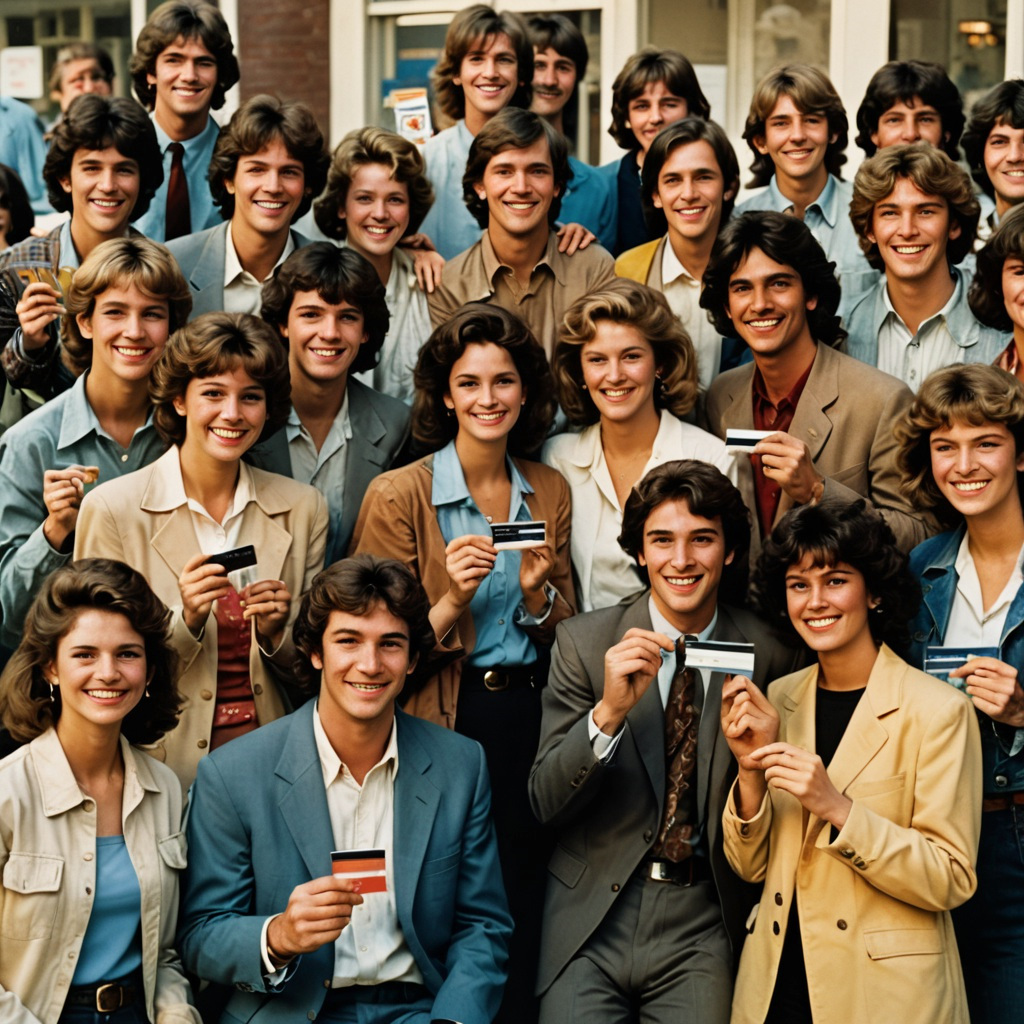
- Credit Cards and Responsibility: We were handed credit cards—the essential tool of the new consumer economy—and told we were adults. This instant access to debt, combined with the lack of financial education, was a radical experiment. We learned that economic risk was no longer buffered by the state; it sat squarely on your own personal balance sheet.
- Pop as Commerce: This era also finalized the link between pop culture and commerce. Music wasn’t just art; it was mass-market commodity. Pop stars were million-dollar franchises, teaching us that to succeed in the new economy, you had to be a brand, loud and well-marketed.
The Anthropocene Audit: Consume and Discard
The acceleration of the free market, coupled with globalized, low-cost manufacturing, cemented our generation’s role in the Anthropocene. Deregulation made it easier to extract, produce, and discard. The constant availability of cheap goods—the foundation of our consumer culture—was not just a convenience; it was the inevitable, globalized outcome of this seismic economic shift.
 Vintage Viv
Leave a comment